
Thorny
- Susun Weed

- Dec 16, 2025
- 4 min read
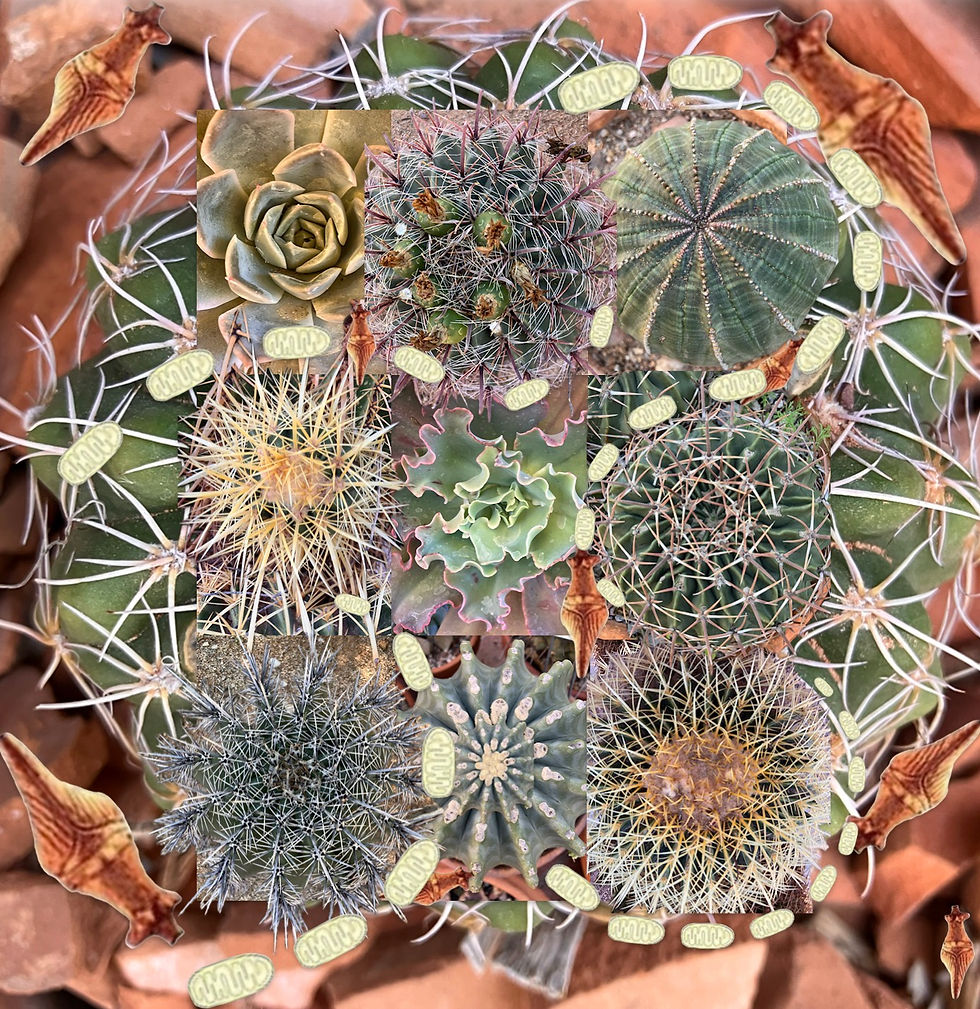
It can seem like everything here in the Sonoran Desert is thorny.
I got jabbed picking a mesquite pod.
Betsy got stuck trying to show me
Woolly tomentum on the golden barrel cactus.
And beware those super sharp agave thorns.
Their sap is intensely irritating.
But it turns out some of those thorns aren't thorns at all.
They are spines.
"Thorns are modified stems.
Spines are modified leaves."
Roses and raspberry bushes have thorns.
So does mesquite.
But cacti and agave have spines, not thorns.
"Cacti have clusters of spines,
Which occur in the axil of leaves."
Uh? Leaves?
"The leaves are usually microscopic."
Yeah.
Clusters of spines is a "defining feature of cacti."
Spines are different from glochids.
If I'm walking barefoot
And step on a spine cluster
I can pull it out.
Hardly painful at all.
And if I'm unaware,
Spines may jab me while I'm
Seeking the perfect angle
for a photo.
Annoying, but not very painful.
Glochids hurt.
You may not even notice them
They are small.
And aren't painful at first contact.
But once on you, their tiny barbed hairs create frustrating pain.
Because you can't just pull them out.
"Glochids or glochidia ("glochidium") are hair-like spines or short prickles, generally barbed, found on the areoles of cacti in the sub-family Opuntioideae."
Opuntia = prickly pear = nopales = sabra
Opuntia are the manna of the desert.
Betsy and I snack on dried prickly pear fruit.
The leaves —
Minus glochids —
Are delicious,
Though a bit slimy.
Want to eat it?
You can.
Prickly pear grows everywhere,
Even in my northern garden.
Here's an amusing, and accurate, account
Of the specific steps you need to take
To safely eat cactus pads.
.
(Heavily edited for length.)
"My first encounter with cactus pads was in Mexico, where I was introduced to Ensalada de nopales — literally 'cactus salad'.
"I was sceptical but completely won over when I tried it.
Cactus pads have been a staple in Mexican cuisine for centuries.
I couldn't believe that I had been driving past kilometres of prickly pear plants and not ONCE thinking. Hey! These could be edible!
"All this time, we've been completely preoccupied with prickly pears — the cactus fruit — regarded as a superfood.
"The edible cactus pads, when cooked, taste similar to green beans but more lemony and their texture is similar to okra.
"Cactus pads are low in calories; one cup has less than thirty calories, and less than five grams of carbohydrates — three of which are from fibre and less than two from natural sugar. Plus, a quarter of your RDA for calcium and 15% of your vitamin C RDA.
"Tips for foraging the perfect cactus pads without needing to go to the polyclinic for cactus spine invasion. [Glochids, actually.] [And instructions for making Ensalada de nopales.]
1. Wear thick gloves or use tongs, as the spines [glochids] are extremely irritating when lodged in the skin.
2. Pick young pads about the size of an adult hand, and half an inch thick. Bright green and bendy cactus pads will be the most flavoursome and succulent, and they will have fewer spines. Thicker, older pads have a thicker sap, which many people find unpleasant.
3. Cut the prickly pear cactus pads with a sharp paring knife. Be sure to leave an inch of the stem behind for it to re-sprout. Cutting is preferable to twisting off; it is less stressful to the plant and helps keep the plant healthy.
4. Collect the prickly pear cactus pads into a large container or even wrap them in the newspaper.
5. Remove the spines [and glochids]. I can't emphasize this enough: protect your hands; wear gloves! Three ways to do it. Hold the cactus pad from the stem end and force a knife against the grain. Or, peel the pads with a potato peeler. Or burn off the spines with a blow-torch or over a flame using the tongs. [That's how I've seen it done.] Double-check carefully to make sure you haven't missed any spines, because they won't miss you. Rinse well.
6. Place a pot of water on the stove and bring to a boil, adding a hefty pinch of salt. Slice the cactus pads into 1 inch pieces and add to the pot. Boil for about 15-20 minutes, or until tender. Drain well.
7. Place a skillet over medium-high heat and add a bit of oil — not too much. Add the sliced prickly pear and a pinch of salt and cook for a couple of minutes.
8. Cover; reduce heat to medium. Let cook and sweat about 20 minutes, or until the goo has seeped out and dried up.
9. Cool. Dress with feta cheese, sliced radish, grilled corn, lemon juice and oil."
And one last interesting fact about cactus spines for your delight.
"Cactus thorns (spines) help collect water, primarily from fog and dew. They have specialized structures that cause tiny water droplets from fog to condense, merge, and roll down to the plant's base, where they are absorbed by the roots."
It is all in beauty.
Spines are part of the beauty.
It is always a giveaway dance.
Some giveaways are sharp.
We breathe with the plants.
Our hearts beat as one with the earth's heartbeat.
We are surrounded by green blessings.
Some of which have thorns and spines.
Gratitude
Joy


